The road network maintained by the MidCoast Council in New South Wales is regularly under pressure, but when major rain and flooding hit the region in 2021 the issue was on the way to becoming a crisis.
The council has a problem which is common to many regional local government authorities: it is charged with the maintenance of over 3600 kilometres of public roads – much of it unsealed – serving a population of 100,000 people in an area spanning over 10,000 square kilometres and nearly 200 towns.
The road network is the second largest of any council in NSW, and maintaining its condition with limited resources has always been a challenge, with the Council spanning the region from Hawks Nest to Harrington, and incorporating the main population centres of Taree and Forster-Tuncurry.
“We had a major flood in 2021 and it just extended into an almost 18 month period when it rained pretty much two out of every three days,” says Robert Scott, the Director of Infrastructure and Engineering Services at MidCoast Council.
“When we look at comparable councils which have two to three times the population per kilometre of road as us, you don’t have to be a mathematician to understand that it’s harder to raise the revenue to keep the roads in the same condition.
“So what we have is a very large road network and a population which is not large enough to effectively sustain it.”
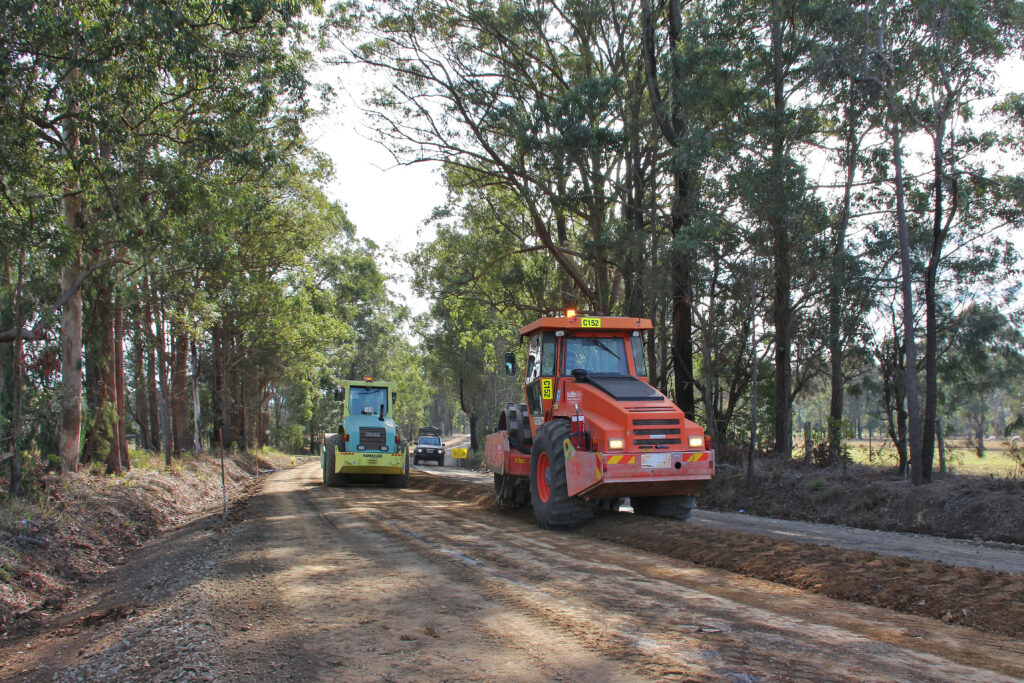
The flooding and the rain brought a further deterioration in the state of the network, creating widespread community frustration which did not always take into account the scale of the challenge facing council, and the resilience and hard work done by its employees.
Scott explains that as part of the response, council embarked on the MidCoast Road Strategy with the starting point of undertaking a deep analysis of the state of the network.
While approximately 70% of the network was rated as being in ‘good’ condition or better, sections in ‘very poor’ condition had a disproportionate impact on public perception. For every three metres, at least one metre was in poor condition.
“The project was to put everything – the history, the current state, plans for the future – into one document,” says Scott.
“It focussed on the options, and it was really about generating the motivation or the momentum for the council to want to do something different in relation to raising revenue to put back into roads.”
The project worked with the Australian Road Research Board to develop different scenarios around levels of resourcing, and the likely impact on the condition of the road network over time.
“We modelled how the network would look in ten years if we just kept on going the way we are, and that was very powerful,” says Scott.
“It painted a very bleak picture for us and told us that we couldn’t really afford to keep doing what we were doing, because the amount of the network in ‘very poor’ condition would double, the amount that is bad would quadruple, and the condition of the overall network would decline by around 25%.”
“It showed that we were on a real precipice and needed a real change to avoid basically riding the network into the ground.”
The strategy saw the redirection of some council funds into the road network from other areas, and prompted more “buy in” from the elected body which gained a better understanding of the challenges.
The strategy has also been the cornerstone to submissions to different levels of government for sustainable funding, laying out the challenge but also articulating the need for change in the way all levels of government fund roads.
It was also able to put dollar figures on the issue. The strategy showed that it would cost $41 million per year to stop the sealed road network from deteriorating further, while $230 million would be needed over one year to lift conditions to an acceptable level, in addition to the $41 million required annually to maintain conditions.
There is also a significant safety dimension to the problem, and Scott points out that people in regional areas are four times more likely to be involved in a fatal road accident than someone living in a city, a risk factor heightened by the state of the roads.
“There are parts of our road network where, if you go more than six inches outside the edge of the road pavement you can be in trouble, so it’s not very forgiving,” says Scott.
The strategy, he says, has been invaluable in bringing all the information on the road network into the same place, based on facts, measured evidence and surveyed data.
It was this aggregation of evidence which enabled a full analysis, but also to “debunk some myths and rumours” and put together a case which showed how the network was being chronically underfunded over a long period.
The strategy delivered an action list of 52 items, around 4% have been dealt with while work has commenced on around half of the list within the existing budget.
“As we get more funding allocated we will be able to pick up more of the projects and start progressing them,” says Scott.
“It has also led to a better understanding of asset renewal and maintenance across our organisation, and changed the attitude of the elected body to start talking to the community about levels of service in the future and their willingness to pay for a better result.”
Robert Scott will be presenting the MidCoast Road Strategy as part of the Asset Management Stream at IPWC 2025, to be held at ICC Sydney from 25-28 of August.