
The global energy transition to renewables has been anything but smooth sailing. As cities around the world grapple with surging electricity demand, growing infrastructure costs, and declining grid reliability, it’s looking like the future for street lighting will need to be off-grid.
Global electricity demand is soaring. In the United States, peak power needs are projected to surge by 30–50% over the next decade, driven by industrial growth and the proliferation of electric vehicles and energy intensive data centres used to power AI. By 2050, energy demand is projected to be 78% higher than in 2023 according to consultancy ICF[1]. With cities struggling to keep up with demand, our electricity grids are under severe strain, resulting in reliability issues and blackouts.
Distributed renewable energy sources like rooftop solar haven’t solved the problem either. Rather, they have generated new challenges. In California, over 2.4 million megawatt-hours of solar energy was wasted in 2022 due to grid limitations. In Spain and Portugal, the 2025 Iberian blackout highlighted the vulnerability of electricity grids overloaded with renewables.
There are other challenges undermining energy security too. In California, planned power outages have become commonplace in bushfire prone areas during extreme weather events. These so-called Public Safety Power Shutoffs (PSPS) affect thousands of customers for days, not just hours. Copper wire theft is another serious problem costing millions of dollars and leaving entire neighbourhoods in the dark. Some cities are literally being stripped for parts, with thieves removing live wires from street lights and selling it for scrap.
The Grid Is Overloaded
Public street lighting is responsible for up to 12% of the total load on the grid at peak times when demand is highest. Reducing this load – even modestly – can dramatically ease the strain. “Reducing street lighting load at peak isn’t just good energy policy – it’s critical grid relief,” says Leadsun General Manager, Lachy Bruce. “Every watt counts.”
Easing the Strain with Solar Street Lights
Solar street lights operate independently from the electricity grid, reducing demand on already strained infrastructure. They have their own on-board solar panel and battery, so they can power themselves. This also means they are less vulnerable to blackouts, natural disasters, and infrastructure failures.
Solar street lights are also less expensive than conventional grid-powered street lights. They eliminate the need for expensive trenching and cabling, making them cheaper up-front as well as over the longer term too, with no ongoing electricity costs and reduced maintenance expenses. As an example, Leadsun’s new VertHex solar light system costs 77% less than an equivalent grid connected system over a 10-year period.
Rapid deployment is another advantage of solar street lights. An analysis by independent engineering consultants ACOR Rudds[2] found that total installation time for 12 kilometres of grid-connected lighting was 17 weeks including planning and specification, underground wiring, lighting installation and connection to the electricity grid. Actual installation times however can be much longer than this, sometimes taking as much as 18 months or more if there are significant delays. In comparison, solar street lights saved four weeks on connections alone, and another six weeks on wiring.
Solar street lights are also environmentally friendly. Powered by clean, green renewable energy from the sun, they have have zero emissions, helping Councils to meet their sustainability targets and reduce their carbon footprint.
Real-World Impact: Murrumbidgee Council Taking Control of Lighting Infrastructure
Murrumbidgee Council in the Riverina region of New South Wales is one of the first councils to side-step developers and the big utility companies and independently install off-the-grid solar street lights powered entirely by solar energy in a new residential development at Darlington Point.
“They wanted a modern, grid-free LED street lighting solution that was economical, environmentally friendly, and engineered to improve safety for residents,” Leadsun’s Matt Pollard said. “With 39 LED street lights powered by the sun, this project may be small, but it represents a significant shift in how councils manage and operate their energy assets.”
Mayor of Murrumbidgee Council, Ruth McRae OAM, said the council is pleased to embrace this forward-thinking concept, with solar-powered LED street lights installed throughout the new River Red Gum Estate housing division. This cutting-edge technology not only enhances sustainability but also ensures the community remains safe and secure.
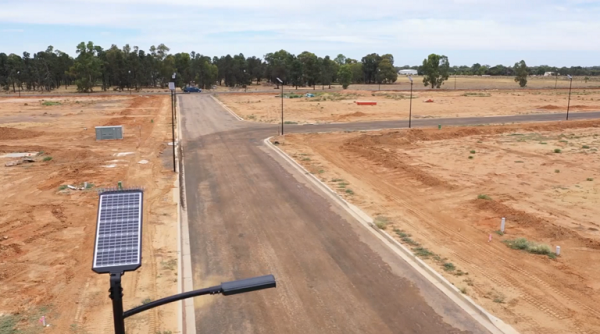
An aerial view of Leadsun’s solar lights at Red River Gum Estate for Murrumbidgee Council. This landmark project gives the council full control of its energy assets from installation through to everyday operation.
The Bottom Line
As technology has improved, solar street lighting has emerged as part of the solution to the energy crisis, reducing stress on overloaded electricity grids and offering unmatched resilience, cost savings, and environmental benefits.
The future of street lighting isn’t just bright – it’s solar.
Leadsun is a SLSC Partner
—
[1] How to manage surging electricity demand, 2025 https://www.icf.com/insights/energy/demand-growth-challenges-opportunities-utilities
[2] Cost Comparison Report between Grid Streetlights and LEADSUN Solar Streetlights, 2021 ACOR Rudds Consultants Pty Ltd