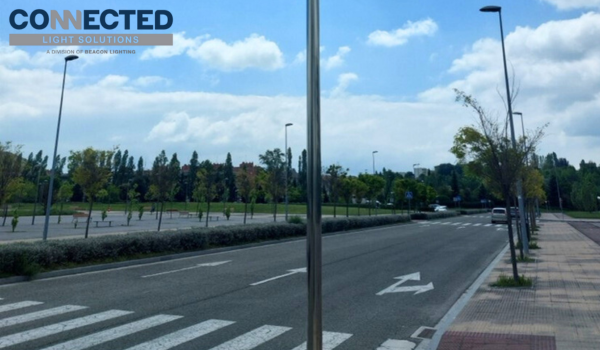
Lighting at pedestrian crossings is a cornerstone of community safety. Properly designed illumination ensures pedestrians are clearly visible to drivers, enhances driver awareness of crossing points, and improves the overall sense of safety for people walking or living nearby.
Across Australia, councils and road authorities are increasingly upgrading pedestrian crossings to meet the latest AS/NZS 1158.4:2024 standard. Both new (greenfield) projects and upgrades to existing crossings (brownfield) are underway, delivering safer, more reliable outcomes for the community.
Why Compliance Matters
AS/NZS 1158.4:2024 specifies the technical requirements for pedestrian crossing lighting. Adhering to the standard ensures:
- Safety: Pedestrians remain visible at appropriate distances and in all conditions.
- Driver Comfort: Glare is minimised, reducing the risk of distraction.
- Community Wellbeing: Light spill onto nearby residences is controlled.
- Consistency: Lighting layouts are uniform and predictable across sites.
Non-compliance can lead to unsafe conditions, community complaints, or costly re-work.
Key Changes in AS/NZS 1158.4:2024
The 2024 update introduces several refinements:
- Reduced vertical illuminance – allows lower-wattage luminaires to achieve compliance.
- Introduction of horizontal illuminance – ensures even lighting across the crossing and adjacent areas.
- Stricter glare limits, with two tiers:
- Brownfield (upgrades) – slightly more flexible.
- Greenfield (new sites) – stricter, requiring precise optics and tilt.
- Practical outcomes – lower wattage and carefully selected optics can achieve compliance efficiently, improving energy performance without compromising safety.
Design Considerations
Accurate design is critical. Note that Perfectlite software does not yet reflect the 2024 standard, so designers are turning to platforms like AGi32 and Lighting Reality to model performance. Key factors include:
- Correct pole placement (typically two per crossing).
- Beam distribution optimised for pedestrian visibility.
- Careful tilt adjustment to meet glare limits.
Luminaire Options
- Floodlights
- Mounted on arms or brackets, directed precisely at the crossing.
- Effective where pole placement is flexible.
- CLS’s Area Lighter range is engineered to comply efficiently with the new standard.
- Streetlight-Style Luminaires
- Mounted perpendicular to the kerb, integrating with existing road lighting.
- New optics distribute light evenly while meeting glare requirements.
- CLS offers a range tailored for Australian conditions.
- International approaches, such as PIR sensors and flashing LEDs to alert approaching vehicles, may offer valuable insights for future Australian installations.
Installation and Delivery
Design compliance must be matched by correct implementation on site. Installers ensure:
- Correct mounting height, tilt, and orientation.
- No shortcuts, such as excessive tilt to stretch coverage, which risk non-compliance.
- Use of glare shields where required to protect nearby residences.
CLS Capability and Support
CLS has delivered pedestrian crossing lighting solutions nationwide and provides:
- Expertise in AS/NZS 1158.4:2024 compliance.
- Site modelling that minimises infrastructure changes and costs.
- A portfolio of compliant luminaires for both Floodlight and Streetlight applications.
- Local technical support and after-sales service to ensure smooth project delivery.
Recommendations for Clients
- Engage early with experienced lighting designers to confirm compliance.
- Verify luminaire certification for Australian standards (Electrical safety, EMC, LM79).
- Include installation quality checks to ensure design intent is realised on site.
- Select suppliers who can provide both technical guidance and practical delivery.
Conclusion
Lighting for pedestrian crossings is more than a regulatory requirement – it demonstrates a commitment to community safety. The updated AS/NZS 1158.4:2024 standard offers opportunities for more efficient compliance but introduces stricter glare controls that demand careful design and product selection.
Working with experienced partners such as CLS ensures projects are delivered safely, efficiently, and in full compliance with the latest requirements.