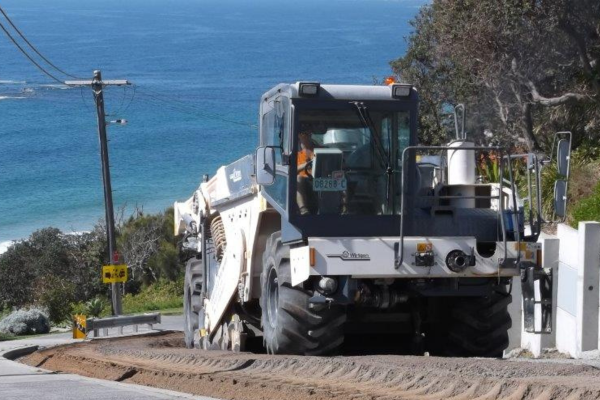
Many people would consider the idea of pavement recycling as just a buzzword, but according to Tanja Conners that future is already here. “The truth is, the revolution has already happened,” said Conners, who is the Chief Executive of AustStab, the Australian Pavement Recycling and Stabilisation Association.
“We know the methods, we know the benefits. The question is no longer what could be done, it’s what is actually being done.”
Speaking at IPWC 2025 in Sydney in August, Conners said that local government was sitting “right at the centre of the issue,” with councils addressing climate change, ageing assets and stretched budgets.
“Councils are really at a crossroads, but the good news is that proven solutions already exist.
“They are scalable, they’re sustainable and they are ready to implement.”
Councils in Queensland are leading the way, Conners told IPWC 2025, with the state embracing pavement recycling as a mainstream solution with councils tailoring projects to their unique needs.
Sustainability, however, still felt like a buzzword in other parts of Australia and New Zealand because it is not often embedded where it matters most, and that is in procurement strategies, project scopes, and funding models.
“Many pavements are well beyond their design life, and with each year of delay the cost of the full reconstruction rises,” said Conners.
“Added to this we’ve got financial constraints that are deepening but sinking capital budgets, especially in regional areas, and that limits the ability to undertake major infrastructure projects.”
Pavement recycling represents a “powerful yet underutilised opportunity” for local governments, which can leverage techniques which re-use existing road materials, thus eliminating the need to excavate and transport new aggregates.
“This dramatically reduces carbon emissions by applying, in situ, methods that can be completed with far less disruption to local communities,” Conners said.
“Most importantly, these approaches offer sustainable financial benefits, and councils have seen cost savings of up to 50%, freeing up funds for broader infrastructure improvements.
“It’s a scalable, climate smart solution, ready for wide adoption.”
Technological innovation, said Conners, was reshaping road stabilisation, and traditional cement was no longer the only option.
Foamed bitumen, especially when enhanced with bio-binders, offered a lower carbon and more flexible alternative which could be applied across a wide range of conditions.
Emulsion technologies also provided solutions for high moisture sites and increased workability without sacrificing strength and meanwhile, supplementary cementitious materials, such as fly ash and slag, had already proven their value.
Conners presented a number of case studies to IPWC which showed pavement recycling in action.
On the Richmond to Winton road in Queensland, for example, in situ stabilisation has fortified flood resilience and the road now remains serviceable even during extreme weather.
Also in Queensland, the Booyal to Dallarnil road has seen success with foamed bitumen paired with upgraded drainage, improving both durability and stormwater performance.
Elsewhere in the state, Cambroon demonstrated innovation through the application of a stabilising agent which reduced the maintenance demand by a factor of 12.
Conners cited a fourth Queensland project, Magee Road, which was reconstructed following a cyclone with a strong focus on using recycled content, “demonstrating that resilience and sustainability go hand in hand.”
On a state level, Queensland’s Department of Transport and Main Roads had three decades of proven performance, embedding pavement recycling as a core tool across its network.
In situ Stabilisation, for example, had been a central strategy on the $8 billion upgrade of the Bruce Highway, funded by Federal and State Governments.
There were also success stories in New South Wales, where Central Coast Council saved 40% in costs while reducing landfill contributions, while in outer Sydney the region of Blacktown has embraced circular economy principles in road renewable practices.
Conners issued a call to action, beginning with a review of capital works programs to identify suitable upcoming projects.
“Design teams must start considering stabilisation from the outset, using the environmental metrics now available to inform design life cycles,” said Conners.
“Councils should request sustainability credit credentials and challenge contractors to provide low carbon solutions.”
It was time, she said, to set the expectation that public infrastructure must serve both people and planet.
“The message is clear, the roads activities depend on can be smarter, greener and more cost effective,” said Conners.
“We don’t need to build new roads to build better ones. We need to reuse. We need to recycle. We need to stabilise and future proof.”