French municipalities have become a real-life laboratory for dimming and switching off street lighting at night, with lessons that are highly relevant to Australian cities and regions.
From energy crisis to normal practice
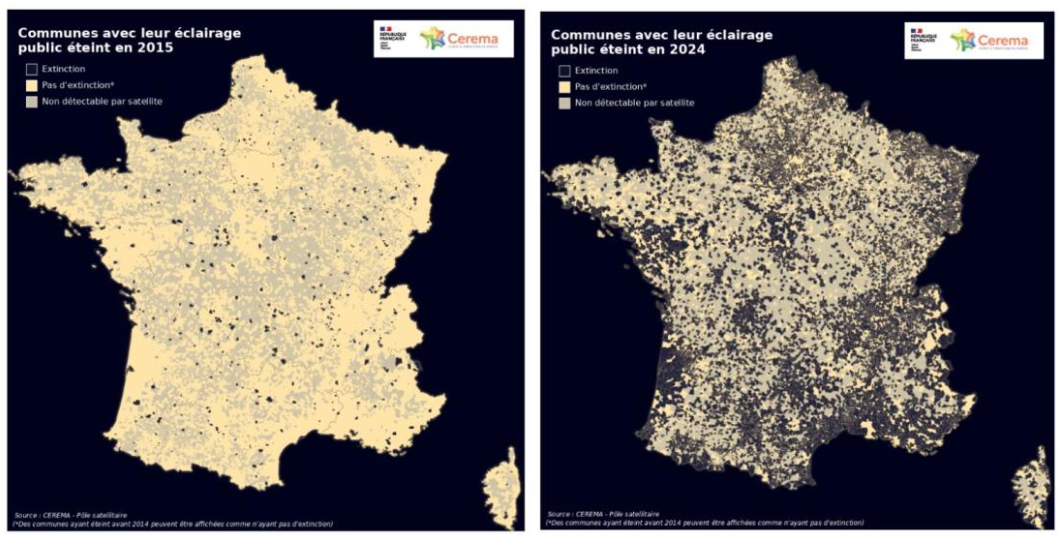
Facilitated by smart street lighting controls, off-peak dimming and switch‑off lighting late at night accelerated in France between 2014 and 2024. As the satellite-generated images above show, there has been a marked change in overall lighting levels in the off-peak hours across France over this period. Indeed, a major step change occurred during the 2022–23 energy crisis. The Russian invasion of Ukraine had sent energy prices soaring and many municipalities cut lighting from around midnight to the early hours to control electricity bills that threatened them with bankruptcy. Public lighting typically represents a large share of local authority electricity costs, so the measure quickly became popular as both a budget and climate tool, and as a way to reduce light pollution and its impacts on biodiversity and human health.
By 2021, France’s environment agency Ademe estimated that around 40% of mainland municipalities had adopted some form of night‑time switch‑off, concentrated between midnight and 4 am, with many more dimming lighting. Towns such as Saint‑Nazaire reported several years of night switch‑off without any increase in police call‑outs, reinforcing the perception among many mayors that these policies could be safely adopted when designed carefully.
Crime, safety and the “dark equals danger” debate
As French local elections approach in March 2026, lighting has become a prominent issue in the French press, with some candidates promising to turn the lights back on in the name of fighting crime. This political narrative leans heavily on the belief that darkness facilitates crime, but recent research tells a more nuanced story.
A major literature review and several UK studies since the 2010s have found no evidence that reducing or switching off street lighting at night increases overall crime in the areas studied. More recently Agence France Press conducted a wide-ranging review of French claims and concluded there was no established causal link between reduced lighting and higher criminality, while strongly distinguishing between objective security and the subjective feeling of insecurity. A new French econometric study covering 2017–2023 found no significant effect of night‑time switch‑off on most crime categories, and only a very slight increase in burglaries – about 0.35 extra burglaries per 1,000 households, mainly in dense municipalities. Importantly, no displacement of crime to better‑lit neighbouring municipalities was detected.
Nevertheless, darker streets clearly heighten anxiety for many residents, especially women and older people, and this has triggered petitions and local campaigns to restore lighting in some towns. The French experience underlines that while crime statistics may be flat, community perceptions and political pressures around safety cannot be ignored.
Towards smarter, not brighter, lighting
Rather than a binary choice between full lighting and blackout, many French cities are shifting to dimming strategies. Lyon, for example, halves the lighting output in some residential areas after 22:00, using smart controls to adjust levels street by street and even temporarily increases or decreases lighting at the request of police. In terms of emerging technologies, some municipalities are trialling motion detection sensors that switch on the lighting or raise it when pedestrians or vehicles are detected, combining safety, amenity and energy savings.
Lessons for Australia
For Australian lighting practitioners, France offers two key takeaways. First, carefully timed dimming (and even partial switch‑off in some areas) in the off-peak hours can deliver meaningful energy, cost and environmental benefits without increasing crime. Second, the main risk is often not more incidents but a stronger perception of insecurity, so careful design of dimming strategies, clear communication and full transparency are essential.
Want to read more? Have a look at these recent primary sources from the French press:
- Faced with insecurity, more and more mayors are turning on public lighting again: Is this the solution?
- Municipal elections 2026: Does turning off the lights at night really increase crime?
- Does crime increase when public lighting is turned off? The answers from an unprecedented study in France
- Beware of claims linking lower street lighting at night to increased insecurity
- Does turning off public lighting at night really increase delinquency?
- France is drowning in electricity: the absurdity of turning off public lighting at night