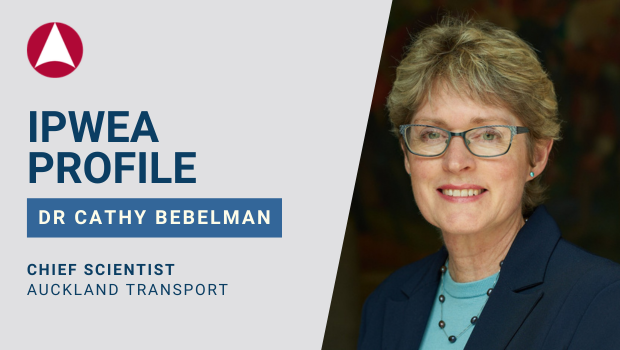
Cathy Bebelman has a simple test for almost every decision: act like a homeowner, not a developer. It’s not a slogan she keeps in a slide deck. It’s the way she talks about public infrastructure, like something you live with, look after, and expect to last. “We are owning public assets for a long time, so we need to focus on designing and maintaining them to reduce that longer-term maintenance burden,” she says.
“When you act like a homeowner then qualities such as resilience and maintenance become second nature in what you do.” This is an approach she has been pursuing for many years through a maintenance-led design approach.
At Auckland Transport, where she is Chief Scientist and Head of Science and Sustainability, that homeowner mindset becomes her day-to-day mission: weaving threads of sustainable practices into the way the organisation operates and keep scanning international best practice so AT stays “up with and hopefully ahead of the game.”
That mission didn’t begin in a transport office. Years earlier she completed a PhD in physical chemistry, then followed the questions that interested her most, water quality, and what happens when infrastructure meets the natural world.
She spent her first eight years working with AT as a consultant, until the organisation persuaded her to come on board as a staff member. As a consultant, she could hand over advice/reports and walk away, knowing it might or might not become reality. “When you are a consultant you can write and offer advice, but you can’t make the client do it,” she says. Inside AT, she could finally follow the full lifecycle of how projects are designed, how they’re constructed, how they’re operated and maintained and always with, as she puts it, “that environment/sustainability lens over the top.”
For the last five years, that lens has sharpened into a major piece of work: a climate adaptation framework and action plan, completed in 2025. While legislation provided part of the impetus, Auckland Council, as AT’s controlling organisation, has reporting obligations, the bigger driver was an internal commitment to delivering better environmental outcomes and a resilient transport system for Aucklanders.
The work accelerated quickly after the Auckland Anniversary and Cyclone Gabrille events in early 2023. At the foundation of the framework sits a series of detailed layers: climate hazard data, asset condition information, climate change risk assessment, critical asset information/locations, vulnerability of transport assets and level of service requirements, the kind of “what state is in, and where might our network be exposed?”.
“The framework allows us to understand which areas of our network are most at risk, and how we can reduce that risk,” says Bebelman. Often the fixes aren’t dramatic. They’re the steady, practical jobs that rarely make headlines: drainage improvements, vegetation work, slope management, small interventions that give the network a better chance of adapting to hazards where possible.
From that foundation and the learnings from the storm recovery work, AT has built a 30-year plan for prevention works. This provides a detailed programme for 10 years and a higher-level approach over the next 30 years and will contribute to the 2027 Asset Management Plan and Council Long-term Plan.
What they’ve learned, she says, is that prevention is so much more cost effective than recovery. In our haste to restore access for communities, we don’t have the time to think about the implications of the work, and we risk locking in a long-term commitment to keep reinstating a road that may have multiple slip sites and the associated costs. Adaptation planning is about taking the time to understand the network and options and working through these with the community before the next storm event.
Bebelman thinks her scientific training is part of why she approaches asset management the way she does. As a scientist, she learned habits that stick, to ask questions, stay curious, and, as she describes it, consider how we might do it differently. “I look at things through a slightly different lens” she says. That lens tends to widen, not narrow. Her background helps her lean into systems thinking, to connect the dots between nature, science, asset management, and the real-world impacts that show up in budgets, designs, and maintenance schedules.
And she sees the sustainability challenge as more than a constraint. To her, it’s a “really cool opportunity” to move how we select materials, design infrastructure and management our assets, beyond older habits. When we make capital decisions we tend to forget that we are building infrastructure that lasts for decades and locks in outcomes for waste, maintenance, impacts on nature, energy requirements, emissions and cost. “The opportunity to change these negative outcomes is enormous – it just requires us to think a little differently and design a little differently.”
For Bebelman, all of those threads tie back to a single idea: “maintenance-led design.”
She’s been championing it for years. And in recent times, building AT’s resilience programme has made that belief feel tangible. “Building the resilience program at AT has really been a highlight of my career over the last few years,” she says.