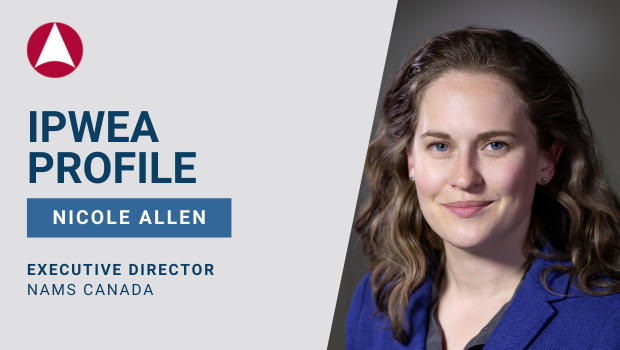
Nicole Allen believes Canada should celebrate its achievements in asset management while maintaining its momentum and continuing to build on the progress the country has made. “There is no ‘done’ for asset management,” says Allen, the Executive Director at NAMS Canada, a not-for-profit organisation founded in 2014 to help local governments improve the management of public assets.
“Asset management is not something we tick off after writing a report and not revisit on an ongoing basis.”
“It has to be a part of how we’re doing business day to day and how we make decisions. It needs to become part of an organisation’s procedures, processes and job descriptions. This is when asset management becomes how we do business.”
Allen has been with NAMS Canada, an IPWEA affiliate organisation, for eight years, a period of significant change in Canadian asset management which began – as it did in Australia – when a change in accounting standards required local government to report on the depreciation of tangible assets.
“This was a big change, because local governments needed to be able to report on their depreciating assets, so they needed to know what they owned, how old it was, and what the assets cost,” she says.
In 2017, Canada’s federal government committed to an eight-year program, the Municipal Asset Management Program (MAMP), which delivered more than 1500 data driven infrastructure and planning projects across more than 2500 Canadian communities.
Over that time, NAMS Canada trained more than 1500 participants through direct NAMS Canada projects and in collaboration with communities of practice.
Allen was also involved in the development of two of IPWEA’s key Professional Certificate courses, and was one of the first course mentors, drawing on more than a decade of experience in training and support.
She came to asset management after graduating as a Civil Engineer at the University of Saskatchewan, and “fell into” the area after a period of working in land development both in Canada and New Zealand.
Her first formal contact with the discipline was as a graduate student when a binder arrived in the mail from the University of Tasmania with materials for an online course.
“When I was going through university, I hadn’t even heard the term asset management,” says Allen. “I think a lot of people of my age or older just fell into it because they ended up landing in a niche – it really wasn’t mainstream. I was lucky early in my career to have some incredible asset management mentors.”
“Asset management has really evolved, and I see that people who are in asset management are passionate about it because it makes a difference.”
Allen’s areas of particular interest in asset management are storytelling, integrated planning, and informed decision making through the effective use of data. While data is important, she warns about the dangers of “getting lost in data analysis and paralysis.”
“People are gathering tons of data but it often isn’t actually changing the outcome,” says Allen. “We don’t need to just gather data for the sheer joy of it. We need data that is going to impact decisions.”
What we need to do is support informed decision making by communicating trade-offs and impacts associated with budget decisions, and this requires us to be storytellers. Ultimately, asset management projects need to be part of a long-term financial plan that is understood and supported by council.
Storytelling, says Allen, is about taking asset management “beyond a 300-page document that few people will read” to having the ability to communicate the impacts of decisions on service delivery.
This might ultimately lead to tough decisions around not renewing assets, or dissolving services because they are unsustainable.
“As technical people we are supposed to be able to help elected members determine the direction of their communities,” she says. “The data is useful but it is not the end game. Informed decision making is the ultimate goal.”
The eight years of the MAMP program has coincided with an increased awareness of the impact of climate change. While Allen welcomes that focus she believes it has also shifted the focus away from asset management.
“A lot of the funding that was going to asset management is now being focused on climate adaptation, often without a focus on integration with asset management and long-term financial planning. This can lead to climate discussions occurring in a silo,” she says.
“If climate risks, adaptation and mitigation plans happen in a silo, they do not become part of the bigger service delivery plan. To ensure these climate adaptation and mitigation plans are achievable and sustainable, they need to be integrated into asset management and long-term financial planning discussions.”
“I see asset management as a foundational aspect of climate discussions as it allows us to understand the impact on service delivery and community outcomes. It becomes just an additional layer on the sustainable service delivery discussion in the asset management plan.”
Without a long-term financial plan, says Allen, none of these discussions can really be meaningful.
Canada has a unique geography and faces a range of climate risks. Tidal issues, coastal erosion, and flooding threaten the coasts, while in Alberta – where Allen lives – the threat is from wildfires, flooding and more. Other parts of Canada are facing flooding, extreme heat, and thawing permafrost.
Much of Canada’s infrastructure was built in the years after World War II, and is coming to the end of its life. This has created a “looming wall of ageing infrastructure” and growing affordability concerns.
“Up until this point, asset management was a ‘nice to have’ best practice for many communities but it is becoming critical because we can’t do everything that we’ve historically done. So the question is: what does that look like going forward?”
“Are there different ways to generate income that we haven’t considered? Or services that we have now which aren’t critical?”
“We have seen some real pockets of success. The communities of practice are amazingly strong and there are passionate people supporting each other with peer learning and sharing.”
“There is quite a lot to celebrate, but my overall takeaway is that asset management is never done.”