By Steve Mooney
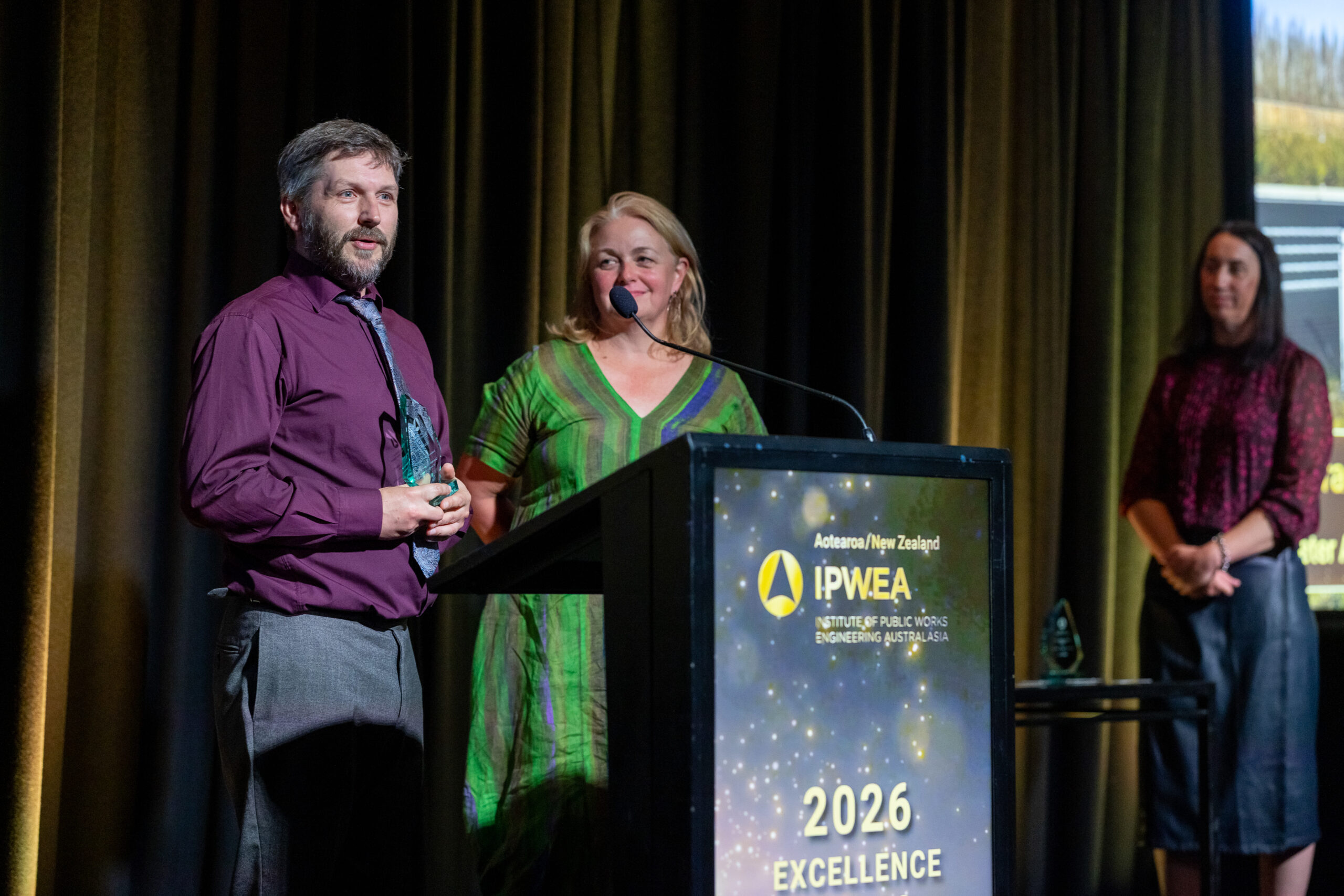
New Zealand asset management and public works professionals joined with IPWEA Aotearoa New Zealand in Auckland on April 30th for the annual New Zealand Excellence Awards Gala Dinner at the Pullman Hotel.
Organisations from around the country entered their projects in eight categories, with the winners announced at an event held in collaboration with principal sponsor Geotab.
IPWEA’s New Zealand Country Head, Steve Mooney, says the awards highlight best practice in the sector and it was a great evening to celebrate outstanding projects.
The awards recognised innovative projects in New Zealand and offered a networking opportunity for industry peers, and a chance to hear a special keynote address from Darren Shand, the All Blacks Manager from 2004 to 2023 in an era often hailed as the team’s golden age.
Read more about three category winners below:
Category: Excellence in Water | Winner: Waimea Water Ltd | Project: Waimea Community Dam
The $211 million Waimea Community Dam is one community’s successful response to the issue of water insecurity and is the largest public works project of this kind in New Zealand this century.
In the heart of Tasman District, the Waimea Plains are a cornerstone of New Zealand’s horticultural economy. The aquifers are the source of public water supply, yet beneath the fertile surface lies a persistent vulnerability: water insecurity.
With only 5% of the region suitable for cultivation, and weather in the key growth seasons becoming drier, access to reliable water is critical. Historically, water management was reactive, with frequent restrictions during dry seasons for both town supplies and irrigators.
These restrictions undermined productivity, strained relationships between Council and water users, and degraded the health of the Waimea and Lee rivers, whose summer flows often dropped below ecological thresholds.
The challenge was clear. Without a long-term augmentation solution, the region’s economic, environmental, and social wellbeing would be at risk.
Officially opened in February 2025, the Waimea Dam is the culmination of 40-years of persistence by many groups and individuals, supported by Tasman District Council, who have been committed to providing greater water security.
The 53 metre high dam in the foothills of the Richmond Ranges can impound 127 billion litres of water and is the first publicly funded dam of its size in more than 25 years, and the first publicly led project of this type since the Clyde Dam in 1992.
The project used a different model from normal regional infrastructure delivery. A mixed funding approach combined public and private investment, with a mixture of private share purchases, public loans, a central government grant and a neighbouring council grant.
To deliver the project, Council and Waimea Irrigators Ltd formed Waimea Water Ltd (WWL) to own and operate the dam.
This Council Controlled Organisation (CCO) enabled shared governance, transparency, financial efficiency and separation of the dam’s financial and operational risks from Council’s core business, while maintaining public accountability through Council ownership and reporting mechanisms.
Economic modelling by NZIER estimates there will be $55 million in benefits in the first two years from the project.
Without the dam, water restrictions of 20–35% were projected with estimated losses of $932 million to $1.2 billion.
Benefits have included new business facilities, expanded food production, and over 1000 new housing lots to ease the region’s housing shortage.
Judges said the dam was a “landmark project delivering water security for 100+ years, with world-leading engineering innovations and strong cultural and environmental integration.”
“The project displays adaptive design under extreme challenges and measurable benefits across economy, environment, and community,” the judges said.
“This is a large and exciting project and there are not many of this type around. There was strong community involvement in the design and planning.”
Category: Excellence in Road Safety | Winner: New Zealand Transport Agency Waka Kotahi | Project: SH1/29 Roundabout
This strategic roundabout sits at a crucial point connecting Auckland, Waikato and the Bay of Plenty, areas which generate around 50% of New Zealand’s GDP and account for 56% of freight movements. With a history of serious safety issues on this stretch of state highway, NZ Transport Agency created a new 60 metre double lane roundabout.
The new design improved safety and connectivity with two underpasses for pedestrians and cyclists, upgraded the stormwater management, improved street lighting and landscaping.
Stakeholder engagement was central to the project’s success. Recognising the site’s cultural, social, and economic significance, the project team worked closely with Ngāti Korokī Kahukura, Ngāti Hauā, and Raukawa iwi throughout the project, whose rohe – or traditional boundaries – meet at this location.
These partnerships led to the installation of Te Manu Rangimaarie – a 12 metre high sculpture by local contemporary Māori artist Fred Graham – symbolising heritage and unity and positioned on the central apron of the roundabout.
The project delivers on the goals in the Government Policy Statement on land transport 2024 (GPS 2024) to enhance safety, expand transport options, stimulate economic growth, and build infrastructure ready for future environmental challenges.
The SH1/SH29 upgrade has transformed a critical intersection into a high-performing freight corridor, improving safety, reducing delays and strengthening connectivity across New Zealand’s most vital economic route within the Golden Triangle.
Judges commended the project as a “high-performing project with innovative technology integration.”
They praised the “strong stakeholder engagement, and measurable safety and environmental benefits” and called it a “benchmark for future infrastructure projects.”
Category: Best Public Works Project $2m to $5m | Winner: Department of Conservation – Te Papa Atawhai | Project: Taranaki Crossing – Pouakai Hut Redevelopment
This winning project connected and upgraded a network of walking tracks and facilities on the Maunga, Mt Taranaki, as an integral part of the Taranaki Crossing.
The Pouakai Hut, which sits at 1190 metres above sea level, is a key asset in the Crossing and its redevelopment included the design, engineering, consenting, and construction of a new 34 bunk bookable serviced hut. There are also two wardens’ bunks in a separate bunkroom with extensive outdoor deck and seating areas.
The hut was co-designed with Ngā Mahanga a Tairi, with early engagement and cooperation between Department of Conservation engineer Jacob Borchers and Ron Pynenberg Architects which resulted a hut design that is functional, subtle in the landscape, and strong enough to withstand the extreme wind and snow loads experienced at this high-altitude site.
Guiding design principles for the co-design focus group were developed in October 2022 including input from Respect, Manaakitanga, Wairuatanga, Whanaungatanga, Mātauranga and Mouri.
A series of eighteen wānanga sharing and discussions were held to ensure the design of the hut was tikanga lead, reflected the importance of the place and met legislative requirements applying to the unique location.
Specific engineering design was undertaken to reflect the site conditions, geological, wind speed and snow loading to ensure compliance with the NZ Building Code requirements.
The project included the demolition and disposal of the existing end-of-life structure and construction of a new Pouakai Hut and associated outbuildings, day visitor facilities, toilets, woodshed, and new grey water system.
It has also included the development, creation and installation of artistic elements developed by Hapū to express the cultural narrative associated with Pouakai and the surrounding environments.
The hut was opened to the public in early August 2025 and has been near fully booked since being available online, providing a significant new facility for the 50,000 visitors who pass through the site on their way to the Pouakai Tarns each year.
The judges praised the project for its “outstanding cultural integration, sustainability leadership, and technical innovation in alpine conditions.”
“The project combines cultural partnership, innovative engineering, measurable community and economic benefits, and enduring sustainability outcomes in a challenging environment,” the judges said.
If your organisation is working on a Public Works Project that will be completed this year, submissions for the 2027 Awards will be open later in the year.