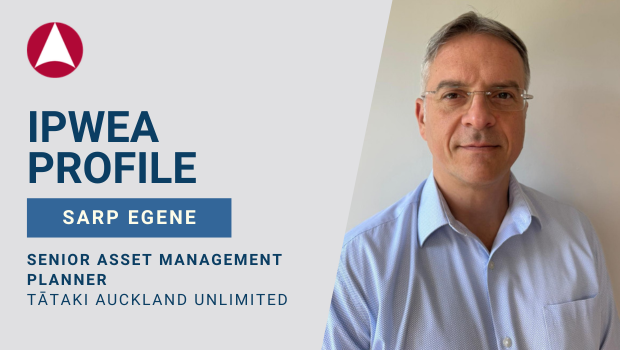
Sarp Egene used to sit in meetings and do a mental calculation of the hourly pay rate of everyone in attendance. He would tally that up and arrive at a final figure and then consider if the meeting had delivered that amount of value.
In many cases, it didn’t.
While he doesn’t do these calculations so much any more, it is an approach which epitomises Sarp’s results based approach to what he does.
In a career beginning in his native Turkey and spanning Switzerland, the United States and now – for more than two decades – New Zealand, Sarp’s philosophy as a project manager has been to work by “stealth.”
The measure of success is for the benefits he delivers to the organisation which outlast his tenure.
He is also not bothered by finite length contracts, as he believes they help keep him on his toes to deliver good work. “I also think I’m more effective in roles where there are complex issues which are difficult to resolve, and where there might be some political or cultural tension,” says Sarp.
“Perhaps it is because I grew up in Turkey and among organised chaos, but I am comfortable with that and have an ability to help people navigate their way out of ambiguity.”
Since relocating to New Zealand Sarp initially had a series of project management roles in the private sector, but in recent years he has moved into the public sector with Auckland Council, Auckland Transport, the National Emergency Management Agency and now in his current asset management role at Tātaki Auckland Unlimited.
Tātaki is an Auckland Council CCO and it is Tāmaki Makaurau Auckland’s cultural, events and destination agency and delivers a range of events and programs. The assets are diverse, spanning the Auckland Zoo to the Art Gallery and the North Harbour Stadium and many other facilities.
“Our purpose is enriching the cultural life and the vibrancy of Auckland, and our team does that by looking after the assets and we do that by positioning asset management as an enabler,” says Sarp.
“We handle the contract management, facility services and capital projects, so we have touch points in everything.
“One analogy which describes what I do is that I’m like a drummer in a band. I don’t do anything fancy, other people get the credit and I need to keep playing so that other people can jump in and do their part.”
While the focus is on the singers and not many people will notice if a bassplayer misses a few notes, everyone will notice if the drums drop out, making it an essential component in any performance.
Sarp notes some changes in the way Tātaki has operated in recent years, with an aggregation and sharing of data across wider teams in the organisation.
“It combines work requests, the projects we are running and our maintenance schedules,” he says.
“It helps with understanding when things are broken and what we should do, and what are the risks we are facing.
“We’re bringing all that data into one place so that the teams can see it and say ‘if I put a work list here it will then impact on the asset condition data, and that will turn into a project which will impact maintenance.’”
Sarp says Tātaki refers to an asset management maturity score, which was basic several years ago and is now at the intermediate stage.
Digital asset management plans have also been implemented, using IPWEA templates.
“We’d see that maturity score improvement as a significant jump, but there is also the difficult to quantify but also qualitative way in which our team does its work,” he says.
“We’ve developed some internal KPIs, such as are our critical systems down, are we checking critical assets, are we meeting up at all times.
“But more than that, we are starting to work together more, so rather than saying ‘I am the capital projects or the contracts management team and I don’t really care what happens after that’ we are looking things more as a whole.”
To return to the band analogy, Sarp says “this is where the band starts playing better together” and the sound improves.
It has also meant that the organisation, as measured by the performance of the assets, has been able to improve using the available resources rather than necessarily having to spend more.
Committing to asset management planning has also been a catalyst for looking further into the future, beyond the short and medium term.
“We are talking about what customer behaviour might be in 30 years’ time, and many of us have just been operating with a focus on the here and now,” says Sarp.
“And that leads to conversations about what we need to start doing now, or in five to ten years’ time, because we understand that it has to be a gradual process.
“That helps us identify the big milestones so we can structure a program of work over time, and build towards success over the longer term.”
Sarp Egene is speaking at the upcoming IPWEA Aotearoa Public Works Forum on Thursday 20 April. Visit our website to learn more.