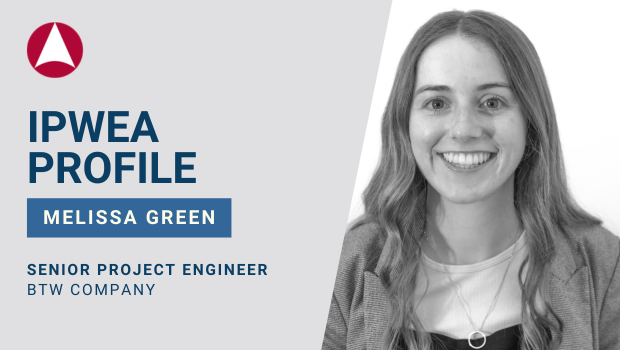
Melissa Green has only recently begun her career in asset management but has witnessed a lot of change in a short period of time.
“When I started working everyone had desktop computers fixed to their desks, but now everyone has laptops and takes devices out into the field,” says Green.
“When I began at council, if someone was to go and fix a leaking pipe they would write down on paper what the job was and then someone would put it into the database. Now there’s a of artificial intelligence and smart tools, and data has become so much more important.
“These days we have a digital platform which eliminates so much of the manual double handling and also gives us data which we can use for decision making.”
Melissa has racked up some significant accomplishments in her career so far.
In her undergraduate Bachelor of Engineering at the University of Canterbury in New Zealand, she developed knowledge and skills in the Waters Sector and progressed through roles at the Waipa District Council from Graduate to become the Senior Stormwater Planning Engineer.
From local government, Melissa moved into consultancy at Te Miro Water Consultants before taking up the role of Senior Project Engineer at BTW Company in Hamilton, where she works closely with local government on water management.
BTW has a 50-year track record in the professional services industry, offering expertise in areas spanning civil and structural engineering, data platforms, data, drones and surveying in addition to water infrastructure intelligence.
Melissa became involved with IPWEA at an early point in her career and completed her Professional Certificate in Asset Management Planning in 2021.
IPWEA, she says, has enabled her to connect with peers and understand the breadth of the asset management profession.
“I’ve enjoyed developing relationships with other professionals and discussing what they are working on and how we might work together,” says Green.
“It has been great to be able to share the experience and the knowledge, and take that back to your role and your organisation.”
Melissa’s path was set towards engineering from an early recognition of her high-level skills in mathematics and science. This was recognised at school where career counsellors pointed her in the direction of engineering.
In her final year at university, Melissa’s major project was on stormwater and this progressed to a career in water management, which is a growing priority in New Zealand.
“Stormwater was a hot topic at the time and there was a real need for more skills in that area, and that led me towards it. It is a real focus because of climate change and the weather events we have had, and there have been some major floods in New Zealand.
“We need to get better at maintaining our stormwater networks and managing the infrastructure assets around that to work with the natural environment to keep people and property safe.”
While much stormwater is diverted out to the ocean, it was becoming common practice to install detention tanks to capture water which can potentially be used for non-potable supply purposes.
The water management sector is also experiencing change, with new council-controlled organisations managing water services.
“I think this is going to have big impacts on how we manage resources, and I’m really looking forward to being involved in that,” says Green.
“I’m keen to see how I can continue my career in this space and be part of the changes in the local government sector.”
Her achievements were recently recognised at the recent IPWEA Aotearoa Public Works Engineering Excellence Awards in May, where she received the Young IPWEA Emerging Leader Award for 2026.
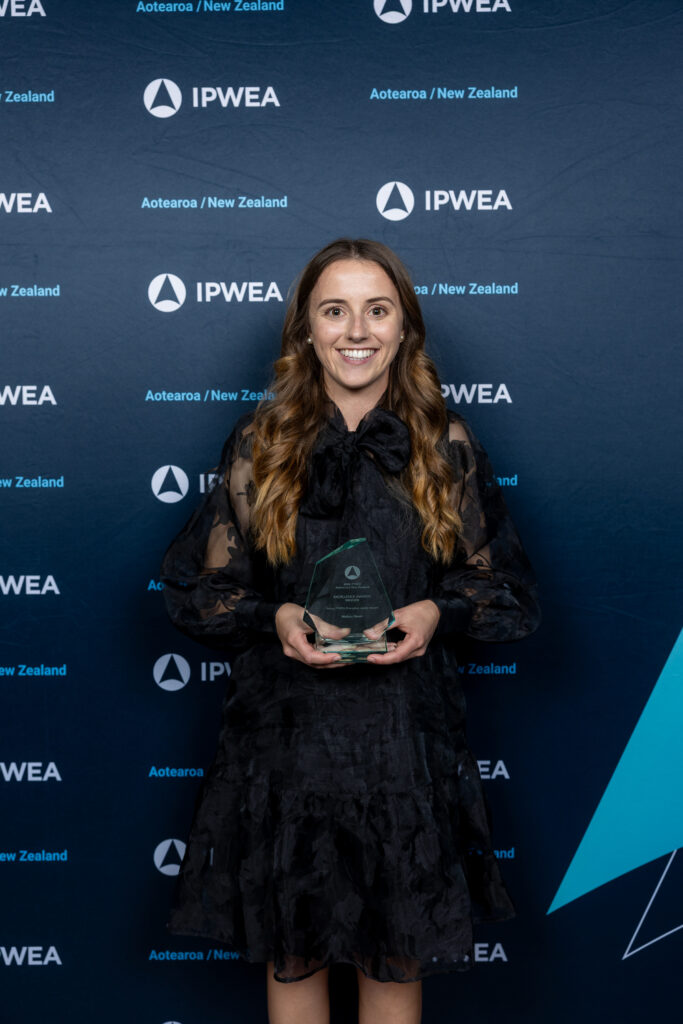
“I was really proud of receiving that acknowledgment,” says Green. “It is exciting and really cool to have that behind me for my next steps as I continue my career.”
Melissa acknowledges that engineering has been a male dominated profession with a reputation for having a “blokey” culture, but says the reality is different in 2026.
“There are more and more females coming into the industry, so that is changing the balance,” she says. “I’ve never had any issues with any of that. I think I can do whatever a guy can do and it’s the same for everyone.”